

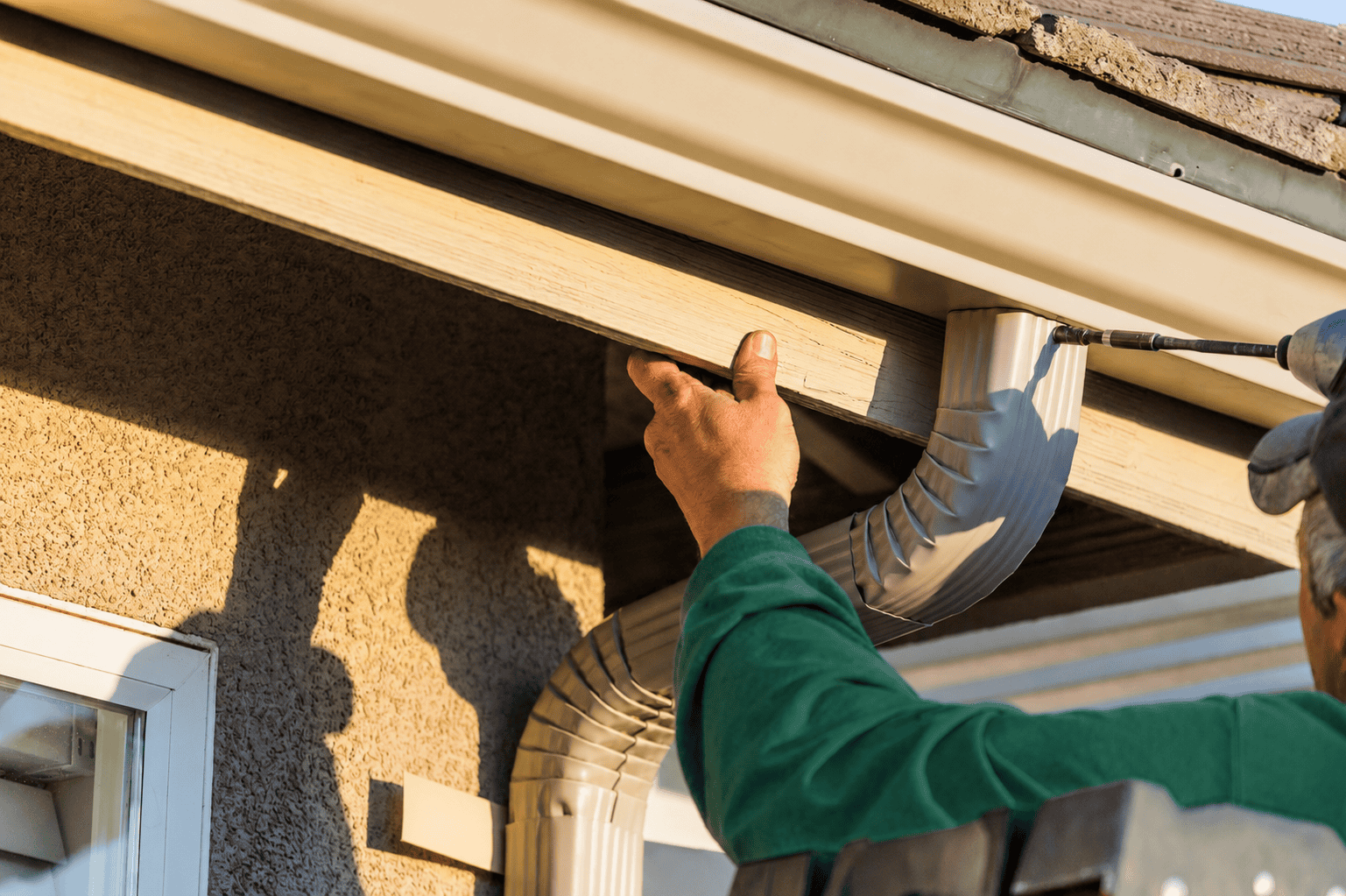
Western Washington gets about 150 days of measurable rain a year. Your gutters are the one part of the house that has to work on every one of them.
So when a gutter estimate comes back with two profile options, fascia or K-style, it is worth understanding what you are actually choosing. Both are real options and we install both as part of our gutter installation work. They mount differently, they handle heavy rain differently, and they age differently. Here is the honest comparison.
The quick difference
K-style gutters are the profile on most homes in America. They have a flat back, a decorative front that looks like crown molding, and they hang from the fascia board on hidden hangers. They come in 5-inch and 6-inch sizes.
Fascia gutters are taller, flatter, and mount continuously to the fascia board itself. Instead of hanging from the fascia, the gutter becomes the face of the fascia. From the street you see one clean line where the roof meets the gutter, with no exposed brackets and no visible seams.
Both are formed on site from continuous aluminum coil, so both are seamless along each run. The differences show up in how they attach, how much water they catch, and how they look.
How they attach, and why it matters here
A K-style gutter hangs from hidden hangers screwed through the back of the gutter into the fascia, spaced every couple of feet. Done right, that holds for decades. The weak point is debris load. In a yard with big evergreens, a gutter full of wet needles is heavy, and every winter it gets heavier. Over enough years, hangers loosen and the gutter starts to pull away from the roofline.
A fascia gutter fastens along its full height directly to the fascia board. The load spreads across the whole attachment instead of a series of points, so sagging and pulling away are far less common. On homes under heavy tree cover, that is the single biggest reason to consider fascia.
Catching the water in a downpour
A Pacific Northwest storm does not always come as a drizzle. When rain sheets off a steep roof, the water leaves the edge with speed, and a gutter that sits too high or too far out lets it overshoot.
Fascia gutters sit lower and tighter to the roof edge, so fast water enters the gutter instead of jumping it. K-style gutters catch most of it too, but on steep pitches or long roof runs, stepping up to the 6-inch K-style is usually the right call for capacity. We measure roof pitch and drainage area on every estimate to size the system, because undersized gutters overflow, and overflow is what rots fascia boards and floods foundations.
How they look from the street
This is the difference most homeowners notice first. K-style gutters read as a traditional trim detail, and they suit most home styles. Fascia gutters read as a clean, modern edge with no hardware showing. On contemporary homes, or any home where the roofline is a design feature, fascia is often the better match.
Both come in a wide range of colors to match trim, siding, or roof.
How they hold up over 20 years
Heavy-gauge aluminum in either profile, installed with proper slope and hanger spacing, should last 20 to 30 years or more. The failure points are the same for both: seams that were not sealed, slope that was never set right, and downspouts that dump water at the foundation instead of away from it.
The roof edge is where gutters, fascia, drip edge, and the first course of shingles all meet, and it is where most leaks start. That is why a roofing contractor installing your gutters matters. We check the drip edge, the fascia condition, and the flashing while we are up there, because a new gutter on a rotted fascia board is a new gutter that fails early.
Which one fits your house
Choose fascia gutters if your home has heavy tree cover, a steep roof, a modern exterior, or a history of gutters pulling away. They cost more per foot than K-style, and they earn it on the homes that need them.
Choose K-style gutters if your home has a traditional look, moderate tree cover, and a roof pitch that does not throw water past the edge. Go 6-inch on larger or steeper roofs. It is the value choice for good reason.
Either way, the system is only as good as the slope, the hanger spacing, and where the downspouts send the water. Those are the things we get right on every install.
Get the right profile for your roofline
We walk the roofline, measure the pitch and drainage area, look at the fascia and drip edge, and recommend a profile and size that fits your house and your trees. No pressure, multiple options.
Your home deserves a roof done right, and that includes the edge of it. Book your free gutter estimate or call (425) 292-8327.
Your Home Deserves A Roof Done Right.
Free 21-point roof inspection, roof and attic. Multiple options, honest assessment, no pressure.
Book My Free Inspection